
How to Specify a 9 cm Zinc Alloy Villa Door
October 20, 2026
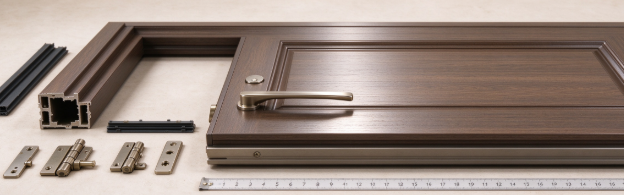
A 9 cm Zinc Alloy Villa Door should be specified as a complete doorset, not by thickness and surface alone. Before requesting a quotation, establish what the 90 mm dimension refers to: the leaf, frame depth, or overall assembly. Then confirm the opening, swing, threshold, finish, lock preparation, and required performance. This prevents fit and hardware mismatches.
Treat 90 mm as a Dimension to Verify
The target keyword points to a 9 cm, or 90 mm, door, but a number without a datum can mean different things between catalogs. Ask the supplier to mark the measured component on a dimensioned drawing. A 90 mm leaf does not automatically mean a 90 mm frame or a 90 mm wall-depth requirement. For a deep exterior wall, the installation may need an extended frame, trim, or a planned reveal; for a thinner wall, the frame may project on one face. Confirm the rough opening and finished opening separately, including flooring and cladding that will be added after the survey.
Measure width and height at several points because masonry openings are rarely perfectly square. As a practical survey, record width at the top, middle, and bottom and height at the left, center, and right; also record both diagonals. These are field-check recommendations, not universal standard tolerances. The manufacturer should state its production tolerance and the installation clearance it needs. Use the smallest measured width and height when checking whether the frame can fit, and note any out-of-plumb or out-of-level condition for the installer.
Clarify What “Zinc Alloy” Describes
A door marketed as zinc alloy may use zinc alloy for decorative panels, cast details, or exterior skins while relying on a different frame, reinforcement, or core. Ask for a cutaway or construction schedule that identifies each component and material. Confirm the thickness of metal sections separately from the advertised overall door thickness. For an exterior entrance, details such as panel attachment, edge protection, drainage paths, seals, fasteners, and finish preparation can affect service life as much as the visible alloy name.
Ask how the finish is prepared and what evidence is available for the intended environment. A coastal site, a shaded humid entry, and a sheltered inland porch do not expose a door to the same conditions. A salt-spray test such as ISO 9227 is a laboratory corrosion test method; a test report should identify the tested specimen, coating system, duration, and evaluation criteria. A generic statement such as “anti-rust” is not a substitute for a defined test or a warranty that explains exclusions.
Specification field | What to record | Confirmation needed |
Target thickness | 90 mm target from product brief | Ask whether it is leaf, frame, or complete doorset depth |
Opening size | Width and height at 3 points; diagonal checks | Supplier to state tolerance and installation clearance |
Wall interface | Finished wall depth, cladding, reveal, threshold | Confirm frame extension, trim, and fixing method |
Construction | Leaf skins, core, reinforcement, frame materials | Identify which parts are zinc alloy and which are other materials |
Operation | Single or double leaf, handing, swing, clear passage | Confirm hinges, lock handing, and handle positions |
Finish | Color, texture, exposure, maintenance | Request finish sample and test documentation for stated environment |
Security | Lock system and target project class | Request complete doorset test evidence if a rating is claimed |
Specify Security as a Tested Doorset
A heavy-looking door or thick leaf is not, by itself, evidence of burglary resistance. The European standard EN 1627:2021 defines requirements and classification for burglar-resistant pedestrian doorsets and related products, with resistance classes from RC1 to RC6 (including RC1N in the system). The classification is tied to the tested construction and its secured condition. If the project requires a class, request the report for the same doorset configuration, including frame, hinges, lock, glazing, and installation conditions. A certificate for one lock or a visually similar model does not establish the rating of another assembly.
Hardware should be selected as a coordinated system. Confirm lock type, number and position of locking points, cylinder format, handle set, hinge capacity, door closer if required, and spare-key policy. Check whether the lock can be serviced locally. For a wide or heavy leaf, the installer and supplier should verify hinge loading and anchorage against the actual leaf mass. Do not assume a zinc alloy exterior panel carries the structural load; the internal reinforcement and fixing points need to be shown.
Check Weather and Thermal Performance Separately
Thickness alone does not establish thermal insulation, air leakage, water tightness, or wind resistance. In Europe, EN 12207 classifies air-permeability test results for completely assembled doorsets after testing to EN 1026. The classes are numerical, so a specification should state the required class and the tested door configuration rather than rely on “airtight.” For other markets, use the local code and accepted test methods. Ask whether the report covers the actual door size, frame, threshold, gasket, and glazing option being quoted.
If energy performance matters, ask for a declared thermal transmittance value for the whole doorset and the method used to determine it. If acoustic performance matters, request a laboratory rating for the complete unit, not a claim based on panel thickness. Threshold height, gasket compression, frame-to-wall sealing, and installation workmanship can change field performance. The drawing and performance report should therefore be reviewed together.
A Practical Approval Sequence
Start with a site survey and a dimensioned opening schedule. Approve the material breakdown, finish sample, hardware schedule, and swing before production. Then review shop drawings showing the 90 mm reference dimension, frame profile, clear opening, threshold, fixing locations, and wall connection. Before shipment, compare the production record and photographs with the approved configuration. At installation, protect the finished surfaces, fix the frame to the specified substrate, maintain plumb and square, seal the perimeter, and test the latch, lock, and seals through a full operating cycle.
The handover should include cleaning instructions, finish-care guidance, hardware manuals, warranty scope, and any performance reports. Record the door identification and retain the approved drawing. This simple document trail makes maintenance and future replacement easier, particularly when the original finish or lock components are not standard stock.
Questions Buyers Often Ask
Does 9 cm mean the door leaf is exactly 90 mm thick?
Not necessarily. Confirm the supplier’s measurement reference and tolerance on a drawing; catalogs can use thickness to describe the leaf or another part of the assembly.
Does zinc alloy mean the whole door is made from zinc alloy?
No. The term may refer only to decorative parts or face panels. Request a component-by-component material schedule.
Can a 90 mm door be called secure without a test report?
Thickness alone does not demonstrate a security class. Ask for test evidence for the complete configured doorset if a rating is required.
Conclusion
A well-specified 9 cm Zinc Alloy Villa Door begins with a clear dimensional reference and a complete assembly schedule. Confirm the opening, frame depth, material breakdown, hardware, finish, and required test evidence before comparing offers. Kepon Doors’ public product pages could not be independently retrieved during preparation, so model-specific construction, dimensions, and certifications should be checked directly with the supplier before publication or purchase.
Article word count: approximately 1181 words (excluding outline, sources, and SEO metadata).